



Tomorrow, the National Mall will host a nine-hour prayer festival called Rededicate 250. It is backed by the Trump administration, partially funded by public dollars, and features cabinet members Pete Hegseth and Marco Rubio, House Speaker Mike Johnson, and Paula White-Cain, the president’s senior faith adviser, alongside Franklin Graham and a roster of evangelical worship leaders. A recorded message from the president will be played. The gates open at nine in the morning, and the program runs until six.
White-Cain has described the event simply: “This is really truly rededicating the country to God.”
That sentence deserves more than a passing read. It means something specific. And the specificity matters.
I spent most of my adult life in charismatic spaces. I know the heat of that room. I know what it feels like when the music lifts and the boundary between heaven and earth goes thin. I am not writing from contempt. I am writing from grief. And from clarity that took years to earn.
Because what is happening on the Mall tomorrow did not just appear out of nowhere. It was built. Carefully, theologically, over decades. And most of the people who will be there, and many of the people watching, have no idea.
What the NAR Actually Is
You may not have heard the term New Apostolic Reformation. That's partly by design. It is not a denomination. It has no membership rolls, no central headquarters, and no statement of faith you can find on a website. It is a theological ecosystem, a set of ideas about spiritual authority, divine mandate, and the nature of the church that has migrated deep into mainstream charismatic and Pentecostal Christianity without ever introducing itself by name.
The ecosystem was largely built by one man: C. Peter Wagner, a missiologist and church growth theorist who spent decades constructing the theological scaffolding for what he believed was a new form of the church. At its center was a claim: that God is restoring the offices of Apostle and Prophet to the church for the first time since the early centuries. These are not honorary titles. In the NAR framework, an Apostle holds genuine spiritual authority over churches, over regions, over culture. And crucially, that authority is accountable to no congregation, no tradition, no creed. It is accountable to God alone.
Wagner himself was explicit about the theological bedrock: "Our divine mandate is to do whatever is necessary, by the power of the Holy Spirit, to retake the dominion of God's creation which Adam forfeited to Satan in the Garden of Eden."
That sentence contains the whole program.
This is not a reformation. It is not a revival in the historic sense, in which movements swept through the poor, the marginalized, the forgotten, and upended established power. This is the construction of a new power structure, dressed in the language of the Spirit.
From the restoration of apostolic authority, Wagner and his network built something more concrete: the Seven Mountain Mandate. The idea holds that there are seven spheres of society: family, religion, education, government, media, arts and entertainment, and business, and that God has called Christians to take dominion over each of them. Not to serve within them. Not to be salt and light in them. To occupy the peaks and rule from the top down.
This is not the historic calling of Christians to seek the welfare of the city, to love neighbors across difference, to pursue justice in public life. That calling I recognize. That calling I share. This is something else entirely.
One scholar defines the Seven Mountain Mandate as "the theocratic idea that Christians are called by God to exercise dominion over every aspect of society by taking control of political and cultural institutions." The call to "take back" the culture is not metaphorical. It is literal.
In the NAR worldview, cultural change is not political or social; it is a supernatural mission. Opponents are not simply wrong. They are possibly under demonic influence. Elections become spiritual battles. Pluralism is a weakness. Compromise is betrayal. Coexistence is capitulation. Newbigin warned that when the church mistakes its own cultural moment for the kingdom of God, it loses the ability to be a witness to anything beyond itself. We are watching that warning come true in real time. He wrote that the church's calling was to be a sign, instrument, and foretaste of the kingdom, not positioned over it. This is something else.
A survey conducted in January 2024 found that 41 percent of American Christians and 55 percent of evangelicals agreed that God wants Christians to stand atop the seven mountains of society. This is not a fringe movement. It is a majority position inside American evangelicalism. And most of the people who hold it don't know it has a name.
Enter Lance Wallnau
Wallnau is the primary translator of Seven Mountain theology for a mass audience, the man who made dominionism accessible, shareable, and politically activating. He has the instincts of a marketer and the confidence of an apostle, which turns out to be a potent combination.
In 2016, Wallnau did something theologically precise and historically consequential: he declared Donald Trump a "Cyrus figure.” The reference is to the Persian king in Isaiah 45 a pagan ruler whom God uses to accomplish divine purposes despite his moral failures. The argument is elegant in its utility: God regularly chooses imperfect vessels. Therefore, moral objection to a leader is not prophetic discernment. It is a failure of spiritual discernment.
This is not a new argument. It is the oldest argument that authoritarians have always made: that they have always needed the church. Every religious legitimization of corrupt power in history has required someone to explain why this time, the normal rules of character and accountability do not apply. Wallnau supplied that argument for millions of charismatic believers at exactly the moment it was needed.
Together, Wallnau and Bill Johnson published Invading Babylon: The 7 Mountain Mandate, explicitly calling for Christian leadership as the only antidote to perceived moral decay. The title is not accidental. They are not asking to participate in Babylon. They are calling for its invasion.
By January 6, 2021, NAR leaders, ideas, and rhetoric had been highly influential in driving thousands of Christians to Washington. Many engaged in spiritual warfare on-site as the insurrection unfolded, praying for Trump's reinstatement as the Capitol was breached. Wallnau had been scheduled to speak at a rally there. It was canceled because of the riot.
The people who walked through those doors carrying wooden crosses and Appeal to Heaven flags were not confused. They were formed. This is what that formation looks like from the inside.
Of all the entry points into NAR theology, the quietest is the most insidious.
Brian Simmons, deeply connected to Bill Johnson and the Bethel network, produced what he called the Passion Translation, marketed as a fresh rendering of Scripture that captures the heart of God. It is listed in the Bible app alongside the NIV, the ESV, and the NRSV. Someone could find it there and assume they were reading what everyone else calls the Bible.
They are not.
The Passion Translation is not a translation. It is a theological document masquerading as one. Consider what Simmons does with Paul's simple greeting, "Grace and peace to you," a phrase every scholar in every tradition renders essentially the same way. In the Passion Translation, it becomes: "We decree over your lives the blessings of divine grace and supernatural peace."
Paul did not say decree. Paul did not claim apostolic authority to speak over his readers' lives. That word decree is NAR vocabulary inserted into Paul's mouth by a man who believes he holds the same apostolic office Paul did.
Or consider Psalm 119, where a Hebrew word meaning "word" or "promise" is rendered consistently across eighteen other occurrences, even in Simmons' own version, which becomes "prophecies" in a single verse. Not from the original text. Not from any scholarly tradition. The change serves one purpose: to reframe Scripture itself as ongoing prophetic revelation, the kind that living apostles and prophets like Simmons can continue to generate.
Simmons has also claimed that he received an additional chapter of John beyond the twenty-one we have from "the Spirit of Revelation, through an angel," a chapter he describes as coming from the Library of Heaven.
When you change what people believe the Bible says, you change what they believe God wants. And when what God wants aligns perfectly with a political program, that is not revelation. That is capture.
Andrew Whitehead and Samuel Perry, whose research on Christian nationalism is the most rigorous we have, argue that at its heart, Christian nationalism demands the preservation of a particular social order in which everyone, Christians and non-Christians, natural-born and immigrants, white and non-white, men and women, recognizes their "proper" place in society.
The NAR is not the whole of that project. But it gave the project its pneumatology. It gave dominionism a theology of the Spirit. It made conquest feel like a revival. It made the seizure of institutions feel like an answered prayer.
We are watching the results. Voting rights weakened. Judicial independence compromised. The bodies of women, immigrants, and queer people are treated as terrain to be occupied. The institutions that, however imperfectly, have functioned as checks on theocratic power have weakened precisely at the moment they are most needed.
The cartoon making rounds this week, Supreme Court justices in their robes raising a Confederate flag in an Iwo Jima pose, the Voting Rights Act crushed underfoot, is not hyperbole. It is a description. The hill has been taken. They were already on it.
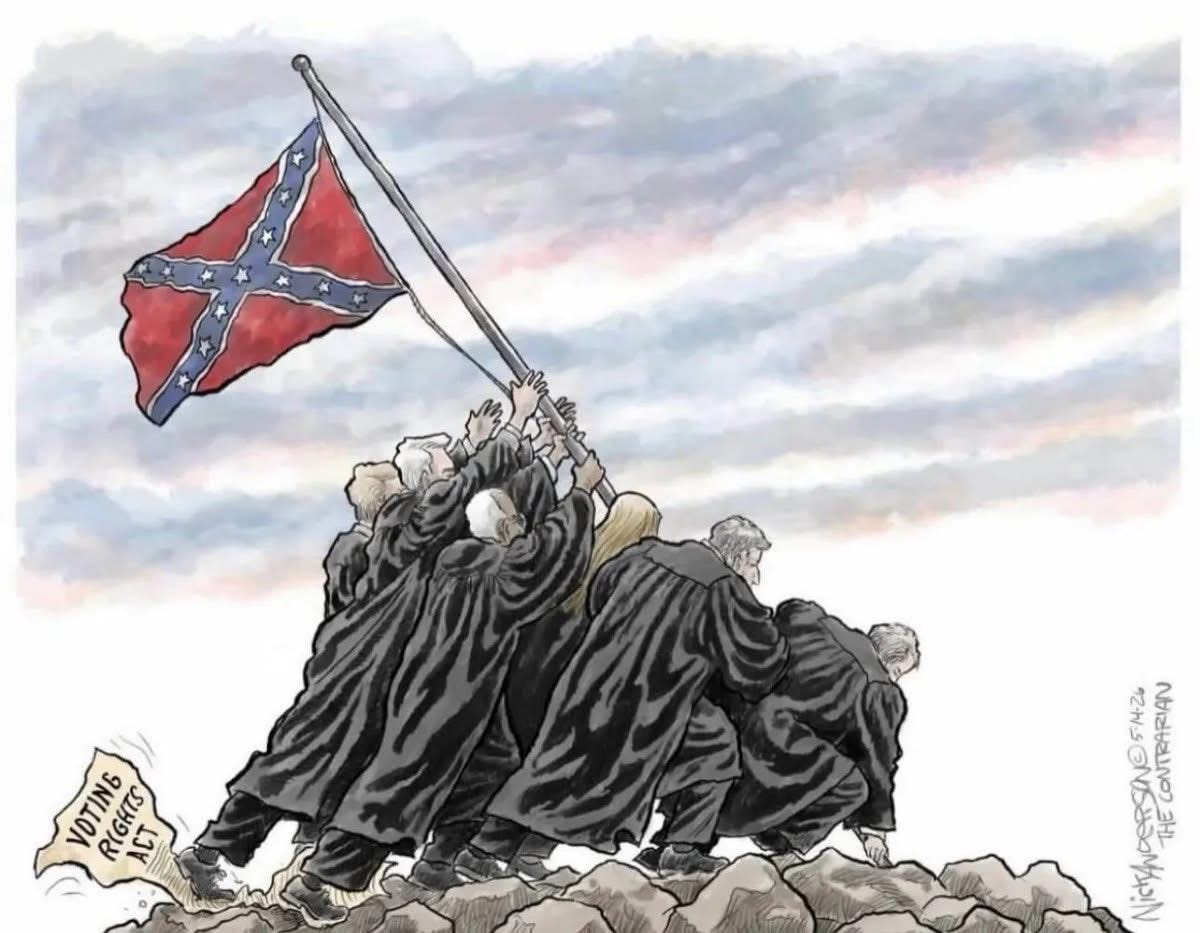
I spent years in these spaces. I have stood in rooms where the music was thick, and the presence was real, and the hunger for God was genuine. I do not believe everyone shaped by charismatic Christianity has been conscripted into dominionism. I know too many people for whom the Spirit's movement has meant the opposite movement toward the poor, toward the margins, toward the costly work of loving people the empire would rather discard.
That tradition exists. It is older, deeper, and stranger than the NAR. It includes the Azusa Street revival, which was led by a Black son of former slaves and drew people across every racial line in 1906 Los Angeles. It includes the Desert Mothers and Fathers, who fled the Constantinian church precisely because they understood what happens when the Spirit gets harnessed to empire. It includes every charismatic community that has ever understood Pentecost not as a mandate for power but as a reversal of it, the Spirit poured out on all flesh, the young seeing visions, the old dreaming dreams, the slaves and the free both receiving the same gift.
The NAR is not a distortion of something that was fine before. Dominion theology has always been available as a temptation. What Wagner, Wallnau, Simmons, and Johnson did was build the infrastructure that made it scalable, digital, musical, and politically legible in time for a particular historical moment.
Naming it is not an act of hostility toward charismatic Christianity. It is an act of love for it.
May we have the courage to call things what they are. May we know the difference between the movement of the Spirit and the movement of empire. May we be found, at the end, among those who washed feet rather than planted flags.

Thank you for the much-needed alarm. I spent two years as C. Peter Wagner's teaching assistant while working w Fuller's D. Min. department. I can consolidate your well-stated orientation to NAR in one sentence. It, (Dominionism) has no theology of the cross. Bless your voice. JSB
This is brilliant, gracious, and foreboding. Thanks for sharing your heart and wisdom, Rose. Keep going.