

Healthy Things Grow
When Numerical Success Becomes a Spiritual Metric

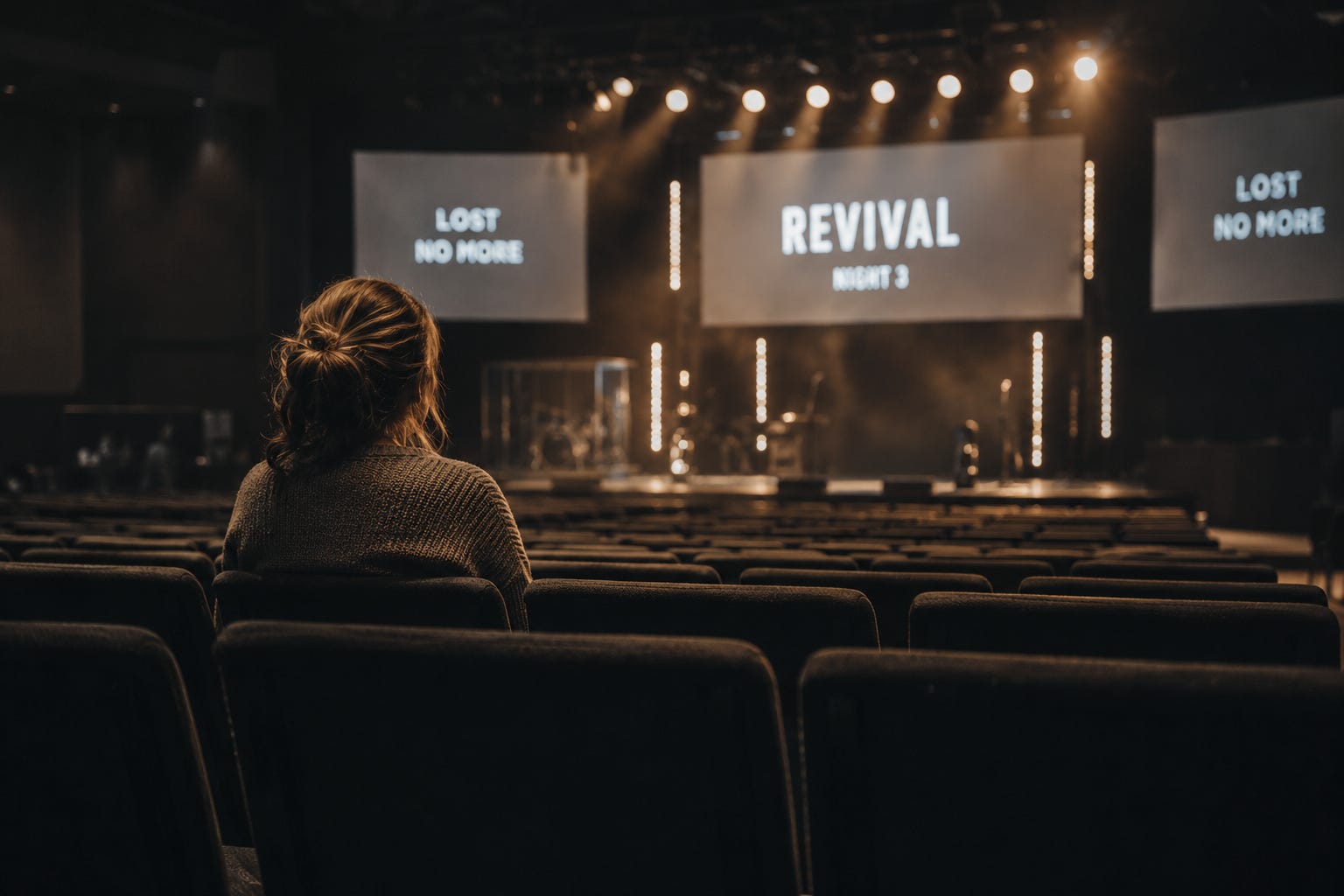
I have been sitting with the response to They Called It Revival.
The messages keep coming. People I have never met, telling me the piece gave them language for something they had carried for years without a name. Not agreement, exactly. Recognition. The quiet relief of hearing someone finally say out loud: you were not crazy for noticing what you noticed.
I have been asking myself why it landed the way it did. I do not think it was because the article said anything shocking. I think it named something many of us were taught we were not allowed to say.
For years, many of us were formed to believe that if something looked spiritually powerful, emotionally intense, numerically successful, or culturally influential, we were not permitted to question it. To question it was to question God. To feel uneasy was to lack faith. To notice manipulation was to be divisive.
So we learned to override ourselves. The body said, “Something is wrong here.” The room said, “This is revival.” I know what that does to a person because I lived inside it.
And I should say this clearly: my story inside the movement was never only harm.
I found healing there. I found a theology of the Kingdom, the now and not yet, that gave language to both hope and disappointment, mystery and longing. After rigid certainty, it felt spacious. Alive. Human.
And in many ways, the movement made room for me long before other evangelical spaces would have. I became the first female Area Leader in the movement, and later one of its first female Regional Leaders. Those opportunities mattered to me deeply.
Which is partly why the grief is so complicated. Love and disappointment often grow from the same roots.
I came into this movement in 1984, at one of John Wimber’s Signs and Wonders conferences in Anaheim. I never knew him well, though I came to know some of his family, and I sat under his teaching the way you sit under something you trust. What I could not have named then was what the room was already built to assume.
In the early years, the movement’s board was entirely male. Their wives could attend meetings. They could voice opinions. They simply could not vote. For years, I sat at tables full of men, some of them complementarians, some biblical literalists, and I learned to choose my words carefully, to edit myself before I spoke, to read the room for how much truth it could bear from a woman on a given day.
I did not call it shapeshifting then. I called it wisdom.
Here is the part I have had to sit with most honestly.
The movement that formed me in my adult years was deeply shaped by the Church Growth Movement — the belief, taught at Fuller and echoed through countless conference rooms like the ones I sat in, that numerical growth was the clearest sign God was at work. And my movement never really left those waters.
Growth became the highest thing we measured. Numbers became how we decided whether heaven was pleased. We heard it constantly from main-stage speakers, nearly all of them leading large churches: “Healthy things grow.”
Really? Cancer grows. Mold multiplies. Empires expand. Algorithms amplify outrage.
Which means the instinct my essay named — that we were not allowed to question what looked successful — was never only out there, in someone else’s revival culture.
It was the measuring stick hanging on my own wall.
And at a table where growth is the highest good, the woman who says something is wrong here becomes a liability. Unease does not produce numbers. It slows them down. So I went quiet. The metric required my silence, and it called that silence loyalty.
Some of those early streams later hardened into forms of apostolic power and dominion theology that now feed parts of the Christian nationalism so many of us are grieving. The lineage is more entangled than many of us wanted to admit. Wimber, to his credit, pulled back from much of it. But I have still had to grieve a hope I once carried: that the movement I gave years to would move further from its tolerance for power, spectacle, and certainty disguised as faithfulness.
This is what I hear underneath so many of the messages. Not only grief over leaders or movements, but grief over what it cost to survive environments where certainty mattered more than honesty, charisma more than character, and performance was mistaken for the presence of God.
People are exhausted. Exhausted by outrage and culture wars. Exhausted by religious systems that demanded loyalty while ignoring harm. Exhausted by trying to hold onto faith while disentangling it from fear, power, nationalism, misogyny, manipulation, and spectacle.
And yet beneath the exhaustion, I keep hearing something else.
Hope.
Not naïve hope. Not triumphant hope. The quieter kind — the kind that surfaces when truth is finally spoken in a room that has long required silence.
I think people are longing for a faith that does not require self-abandonment. A faith spacious enough for grief, honest about harm, unwilling to confuse domination with strength. A faith where the fruits of the Spirit matter more than the size of the congregation, where tenderness is not weakness, where people can breathe again.
I should say this clearly: I am aware of the irony. This essay has found more readers than anything I have ever written. By the one metric the movement taught me to trust, that would finally count as proof that God is pleased.
I no longer believe the metric.
What I believe is that the longing itself, the ache for a truer way of being human together, is holy.
And I believe the body that whispered something is wrong here was never faithless. It was telling the truth before the room was ready to hear it. May we learn to trust it again.
May we learn again to trust the quiet wisdom we were taught to silence. May we have the courage to notice what our bodies already know. May we stop confusing size with health, spectacle with holiness, power with love.
And may the God who meets us not in domination, but in truth, tenderness, and breath, gather the fractured parts of us back together again.
May beauty find you this week. May peace surprise you. And may the love of God at the center of the cosmos, stronger than fear and gentler than shame, hold us in grace as we learn to become human again.
Amen.

Thank you for naming what I too felt.
Thank you, Rose.